
Why Inclusive Sound Is the New Streaming Standard
Clear audio is not a luxury feature; it is the core of how stories, conversations, and live moments reach people. When viewers cannot hear dialogue clearly, they miss plot points, emotional subtleties, and even basic information, no matter how beautiful the visuals are. For streaming, social, and commerce platforms, that gap quickly turns into frustration, churn, and muted engagement.
More than 50 million Americans, roughly 1 in 7 people, live with some degree of hearing loss. That number includes a growing share of younger users, as constant headphone use and loud environments chip away at long‑term hearing. Researchers and product leaders searching for terms like hearing loss statistics 2026 and inclusive streaming demographics are not just chasing data; they are trying to understand how audience needs are changing. At Sound Dimension in Sweden, we created AiFi, a software-only, multi-device audio technology that helps platforms move past basic accessibility checklists into truly inclusive listening experiences that feel natural to everyone.
Hearing Loss Is Wider and Younger Than You Think
When people hear “hearing loss,” many still picture only older adults. In reality, more than 50 million Americans are living with some level of reduced hearing, and that figure does not include everyone who has mild, undiagnosed challenges. Even small shifts in hearing can make it hard to catch dialogue clearly, especially in noisy, effects-heavy mixes.
Younger viewers are increasingly part of this story. Years of listening at high volume on earbuds, attending loud events, and working or studying in noisy environments can create subtle changes that only show up when audio gets busy. Inclusive streaming demographics now include teenagers and twenty‑somethings who find themselves constantly nudging the volume up to follow speech.
For streaming and social platforms, ignoring this shift comes with real consequences. When dialogue is hard to follow, we see patterns like shorter viewing sessions, abandonment of long‑form content, and a quick switch to other apps that feel easier to consume. At the same time, app stores, regulators, and accessibility advocates are all raising expectations around inclusive features.
This is why relying on a single tool, like subtitles, is not enough anymore. Subtitles help some viewers some of the time, but they do not address the core problem: audio mixes and playback environments that make speech hard to hear in the first place.
Subtitles Are a Symptom of a Deeper Audio Problem
There has been a clear surge in subtitle use among people who do not identify as having hearing loss. Many younger viewers keep captions on all the time, even for content in their native language. One key reason is that modern mixes often favor cinematic effects, wide dynamic range, and heavy ambiance over straightforward speech clarity.
Compressed audio, tiny phone speakers, and noisy settings like shared living rooms or open offices make this worse. When dialogue gets buried, subtitles become a workaround. People are not turning captions on because they love reading; they are compensating for audio that is hard to follow.
That workaround comes with costs. Constantly reading text is tiring, especially in long sessions. It pulls the eyes away from performances and visual details. It can also leave out viewers with cognitive or visual challenges who do not benefit from text on screen. Subtitles solve part of the problem, but they also remind people, every second, that simply listening is not working.
At Sound Dimension, we see subtitles as a symptom. The deeper issue is that speech is not being delivered in a way that keeps it naturally clear across devices, rooms, and audiences. The real opportunity is to make voices easier to hear with smarter software, not simply more text.
How Software Voice Enhancement Changes the Experience
Instead of forcing people to crank the volume for everything, software can treat dialogue and background audio differently. Modern processing can separate speech from other sounds, then adjust it in real time so that words stay clear without flattening the experience.
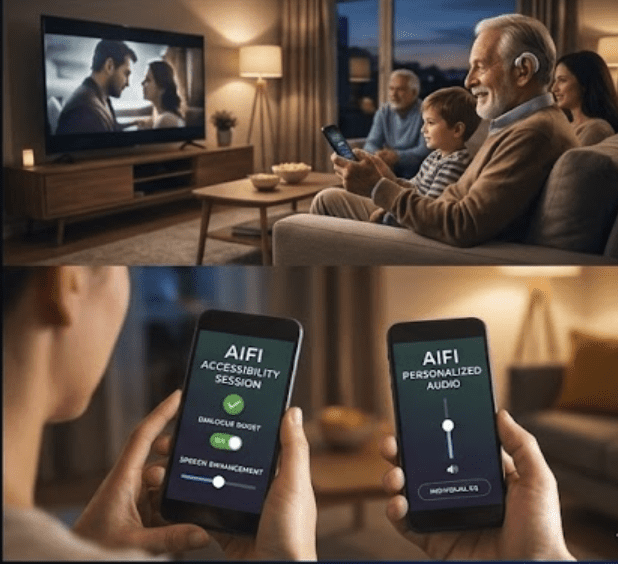
With AiFi, our approach is to analyze the audio stream as it plays, identify the voice content, and create a cleaner, speech-focused version that can be sent to another device, for example, the viewer’s smartphone. Because AiFi is built for synchronized, multi-device playback, the phone stays perfectly in time with the TV, laptop, or main speaker.
This opens a new type of control for viewers. Someone watching in a living room can keep the big cinematic mix on the TV for everyone, while sending a voice-forward version to their own phone at the same time. On that personal device, they can:
- Turn up dialogue without making explosions too loud
- Adjust EQ to suit their own hearing, for example, brighter consonants or less bass
- Move the phone closer for a more intimate, focused listening spot
- Keep overall room volume low while still following every word
The result is not just technical clarity, but emotional comfort. Instead of telling viewers, “read more,” we are helping them simply hear. That respects dignity, avoids awkward volume battles, and keeps immersion intact for everyone in the room.
Turning Every Screen Into a Personal Hearing Companion
Most viewers already have a second screen in their hand while they watch content. That phone or tablet is an unused audio opportunity. A multi-device audio playback API is the missing link that turns those devices into personal, high‑clarity dialogue speakers, fully synced with the main screen.
There are powerful use cases across formats:
- Streaming video: send the cinematic mix to the TV and a voice-focused stream to a phone for any viewer who needs clearer speech.
- Social and live content: let participants boost host or guest voices on their own device during events, AMAs, or live shopping sessions, without extra hardware.
- Gaming and watch parties: give each person their own optimized dialogue or voice chat stream without disturbing shared audio in the room.
AiFi is designed as a software-only, multi-device audio playback API and SDK, so developers can embed this capability directly into their existing apps. There is no need for special speakers or proprietary hardware. Product teams can integrate multi-device audio into their current streaming, social, or commerce experiences.
For developers, this adds a practical set of tools. AiFi is built to work across devices and platforms, so teams can:
- Offer new accessibility toggles like “dialogue boost to phone”
- Create presets tailored to genres or audiences, such as voice-forward drama or commentator focus in sports
- Experiment with different mixes and layouts without changing the underlying content files
Designing Accssible Audio Without Sacrificing Creativity
Sound designers sometimes worry that voice-focused tools will flatten their artistic work. Our view is the opposite. When personalization happens on the listener side, creative mixes can stay rich while still being accessible.
With a multi-device audio playback API, every viewer can lean into their own taste. One person may want strong dialogue and minimal ambiance. Another may accept less clarity to keep the full environmental sound. The content itself does not need multiple versions. The app simply gives each listener more say in how they hear it.
Platforms can make this inclusive by default without making it intrusive. For example, they can:
- Offer clear, simple options like “easier-to-hear voices” in audio settings
- Remember preferences per profile, so viewers who rely on clarity tools do not have to keep switching them on
- Let users adjust settings mid‑stream without interrupting playback
AI-powered analysis can also adapt over time. As platforms learn how people actually listen to different types of content, they can shape smarter defaults for talk shows, dramas, sports, or educational videos, always with the same goal: keep speech naturally understandable while preserving creative intent.
From Compliance to Competitive Edge in Streaming Accessibility
Accessibility in audio is often framed as a compliance requirement. We see it as a chance to make experiences better for everyone. When inclusive sound becomes part of the core product, viewers stay longer, engage more deeply, and feel seen instead of sidelined.
For product and platform teams, a practical path forward might look like this:
- Audit the current listening experience with the full range of inclusive streaming demographics in mind, including younger users who already rely on subtitles and headphones.
- Run experiments with software voice enhancement to see how clearer dialogue affects watch time, satisfaction, and support tickets about audio issues.
- Integrate a multi-device audio playback API like AiFi in limited pilots, such as a “personal dialogue channel” feature on selected titles or live events.
As an audio technology company, our focus at Sound Dimension is simple: do not just make content readable; make it hearable for every viewer. Subtitles will still have an important place, but they should not be the only tool holding the experience together. With smarter software and multi-device audio, platforms can give people what they came for in the first place: a story they can follow with their ears, not just their eyes.
Transform Your Audio Experiences Across Every DeviceUnlock richer, synchronized sound by integrating our multi-device audio playback API into your next project. At Sound Dimension, we work closely with your team to align audio performance with your technical and creative goals. Share your use case, and we will help you design a scalable solution that fits your timeline and infrastructure. If you are ready to explore what is possible, contact us to start the conversation.